St Bridget's has stood at the north end of Skenfrith, a stone's throw from the castle and the river, for about eight hundred years. This page gathers what is known about the building, its treasures and its people.
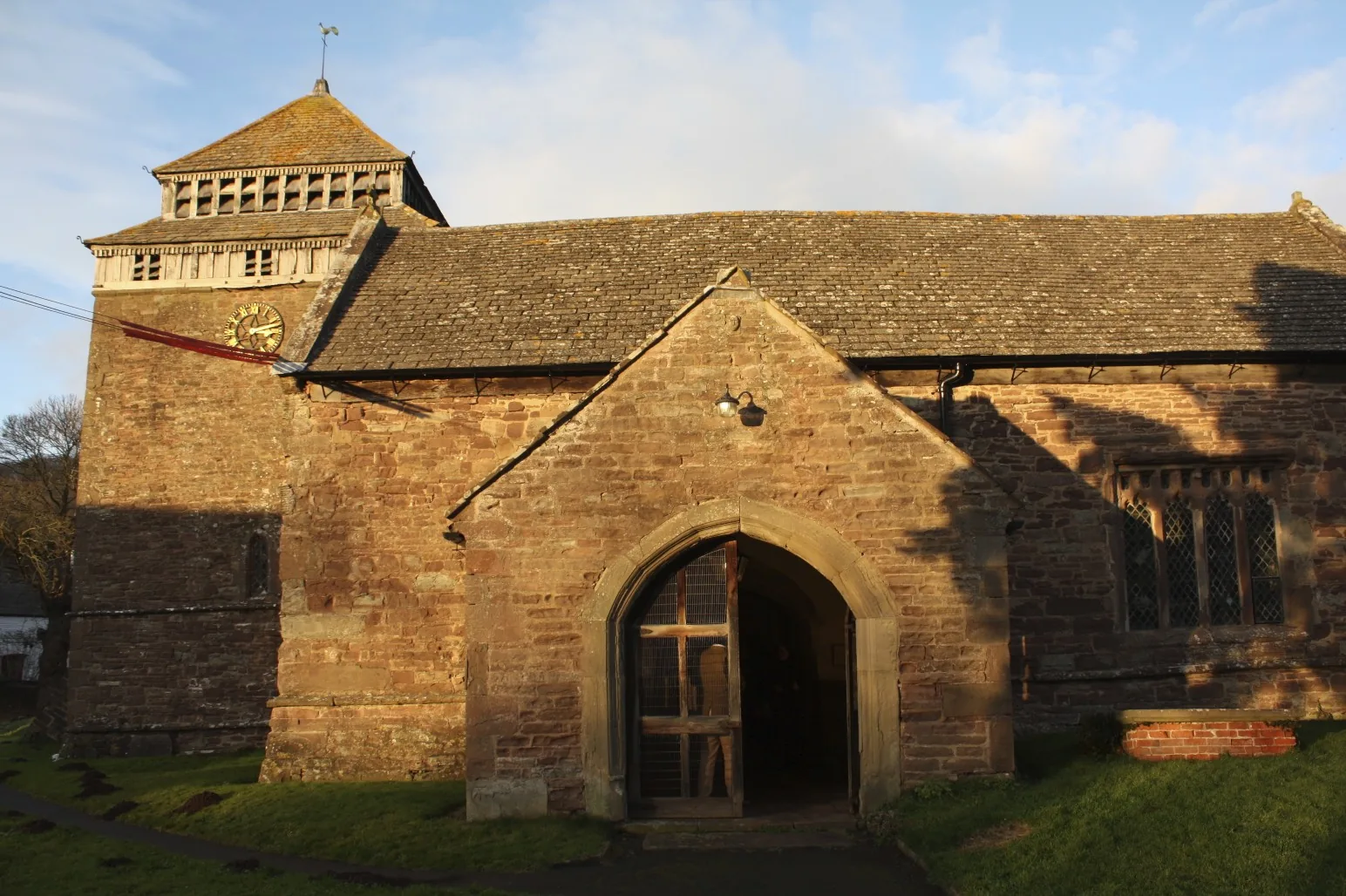
The south porch and the tower with its timber belfry. J. Buchanan
Timeline
Llinell amser
c. 1200
The oldest parts of the church are built, in the reign of King John (1199–1216).
1207
Matthew de Hereford, priest of Skenfrith, pays King John ten marks for leave to hold the church in peace. Later tradition makes this the year the church was consecrated.
1219 onwards
Hubert de Burgh rebuilds Skenfrith Castle in stone, about 100 metres from the church.
1200s–1400s
The north and south aisles are added, and the church takes its present shape.
1291
Edmund, Earl of Lancaster, gives the right to choose the vicar to the Cistercian monks of Grace Dieu Abbey, near Monmouth.
c. 1500
The south porch is built. The Skenfrith Cope dates from about this time.
1557
John Morgan, governor of the Three Castles, dies. He and his wife Anne, who dies in 1564, share the carved chest tomb in the north aisle.
1642
The vicar, David Lewis, is turned out by Parliament’s commissioners for his loyalty to Charles I.
1661
After the Civil War the church is repaired. The font and a roof timber in the south aisle carry this date.
1679–1725
James Phillippes is vicar for 46 years. The communion cup and paten are given in 1693.
1765
On 15 January “the newe six belles first began to ring”. Thomas Rudhall of Gloucester had cast them the year before.
1841
Parson Miller puts a stop to the village wake and the games in the churchyard.
1840s
The Cope, found rotting on the communion table, is recognised and saved.
1847
A Catholic chapel of the Immaculate Conception is built at Coedangred, in the parish.
1889
The Revd Christopher Garde begins 34 years as vicar. Robert Newton Jackson of Blackbrook becomes patron at about this time.
1896
E. G. Davies renews the roofs of the nave and chancel.
1909–10
William Weir restores the church with the Society for the Protection of Ancient Buildings. The Bishop of Llandaff reopens it on 18 June 1910 and consecrates an extension to the churchyard.
1916–18
Three grandsons of the patron, the Thomas brothers, are killed in the First World War.
1920
The Church in Wales is disestablished. About this time the village war memorial is put up beside the road to the bridge.
1953
St Bridget’s is listed Grade I on 19 November.
1983
Kirstie Buckland, who repaired the Cope, publishes the specialist study of it.
2006
The bells are overhauled and rehung in a new iron frame.
2010
Doctor Who films in the village, which plays “Upper Leadworth” in the episode Amy’s Choice.
2013
After a year in a London conservation studio, the Cope comes home on St Bridget’s Day, 1 February.
2019–2025
The Monnow floods the village repeatedly. In November 2025, Storm Claudia puts more than 40 centimetres of water inside the church.
Beginnings
Dechreuadau
St Bridget, or Ffraid
The church is dedicated to St Bridget of Kildare, the Irish saint known in Welsh as Sant Ffraid. Around seventeen churches in Wales bear her name. Her feast day, 1 February, is still kept here: it was the day the conserved Cope came home in 2013.
The village's Welsh name, Ynysgynwraidd, is often said to mean the island or meadow of Cynfraeth, perhaps an early local leader. That meaning is not certain.
Church and castle
No part of the building has been found that is older than about 1200, the reign of King John. The earliest written mention comes in 1207, when the priest, Matthew de Hereford, paid the king ten marks to hold the church in peace. So a church and a priest were here by then.
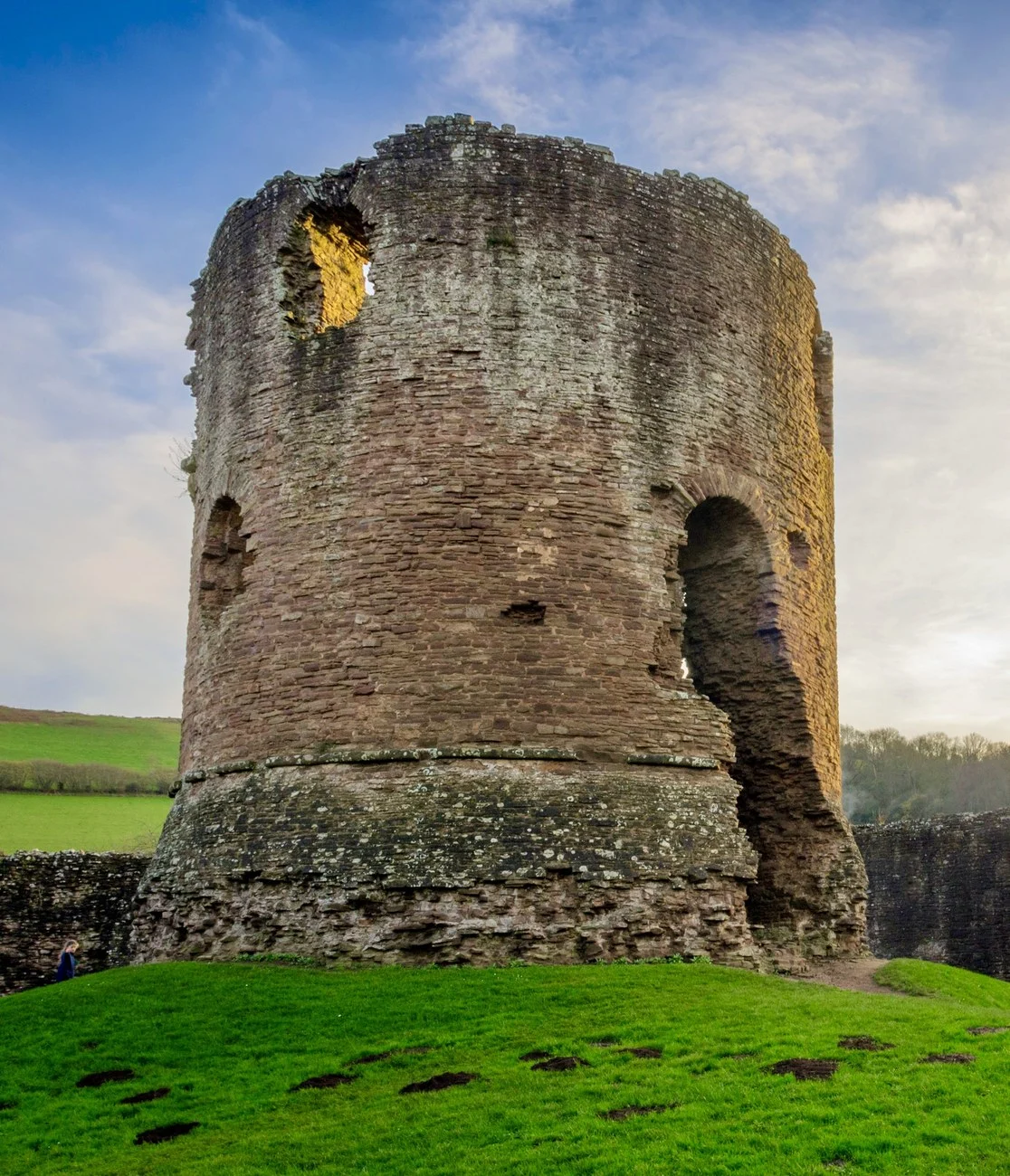
The castle a few steps away was rebuilt in stone by Hubert de Burgh from 1219, and with Grosmont and White Castle it formed the lordship of the Three Castles. The castle was in ruins by the 1530s. The church outlived it and has been in use ever since.
Skenfrith Castle. Warren Williams, 1899
The building
Yr adeilad
The tower and its dovecote belfry
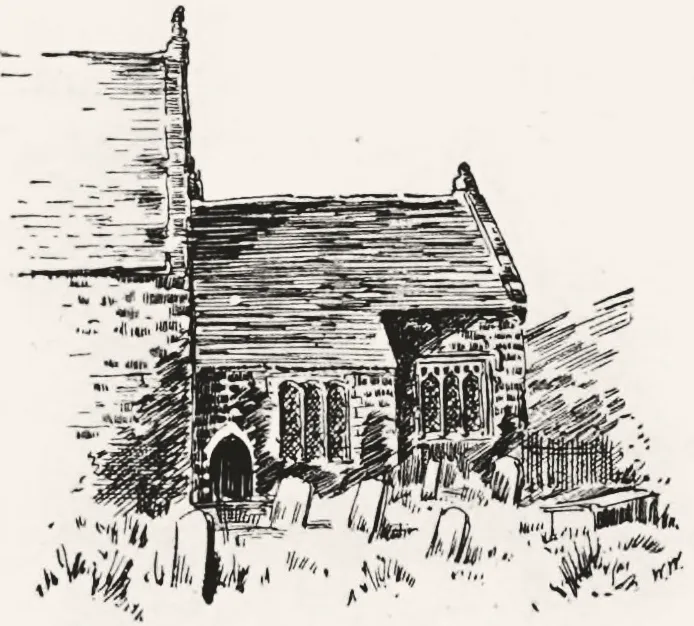
The squat west tower has walls about 1.5 metres thick and only the narrowest openings. A huge sloping buttress props its north-west corner. On top sits a low, two-stage timber belfry with louvred openings and a pyramid roof. It looks like a dovecote, which is where the name comes from. Similar belfries can be seen at Rockfield and St Maughans.
Nave, aisles and porch
Inside, four round stone pillars on each side carry pointed arches between the nave and the two aisles. The aisles were added or rebuilt between the 1200s and 1400s. The south porch, with its heavy oak door and a worn holy-water stoup, came around 1500.
The chancel keeps a 13th-century piscina, the stone basin where the priest washed the vessels at Mass. Steps in the chancel arch once led up to the rood loft, the gallery above the medieval screen.
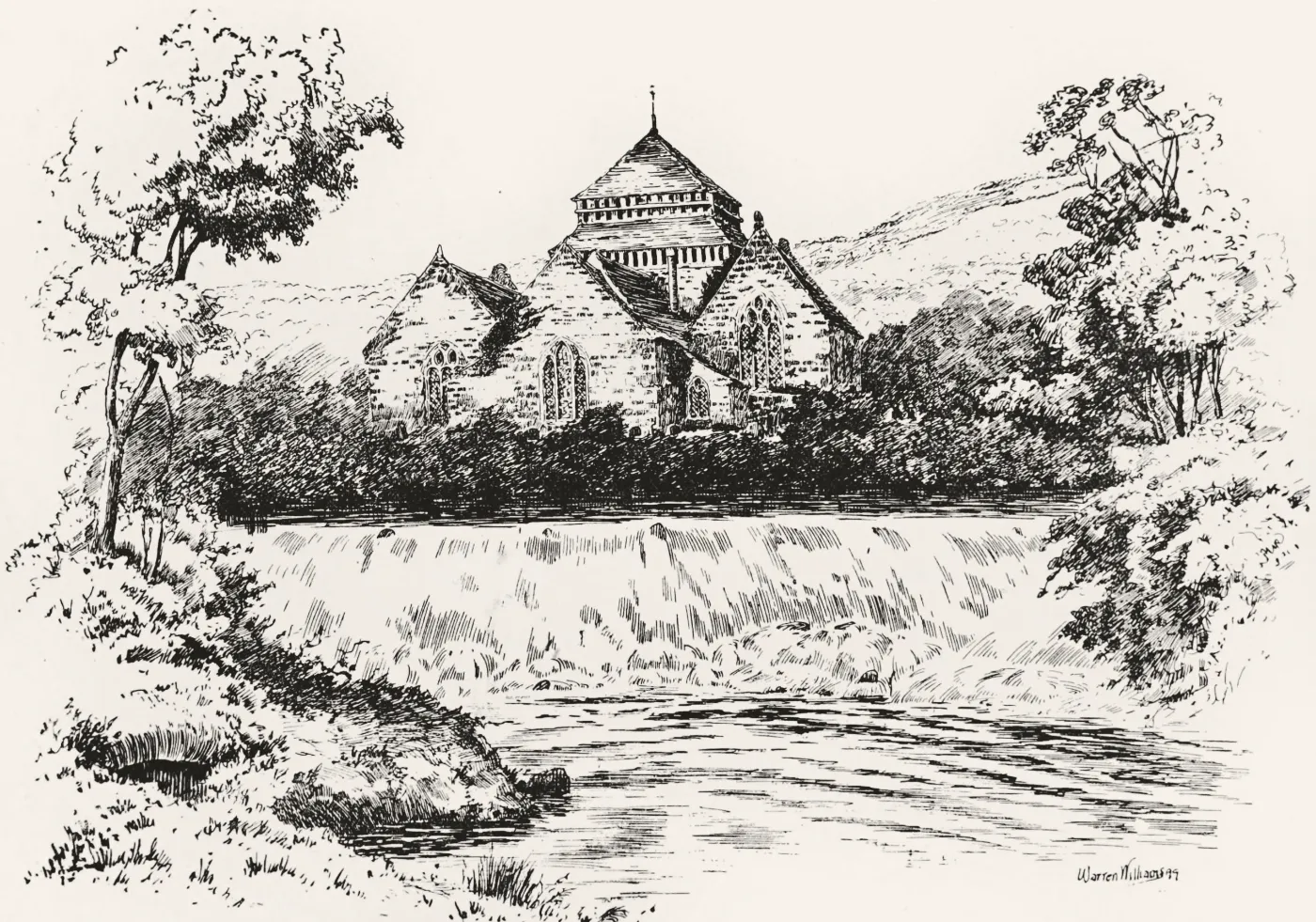
The church from the weir. Warren Williams, 1899
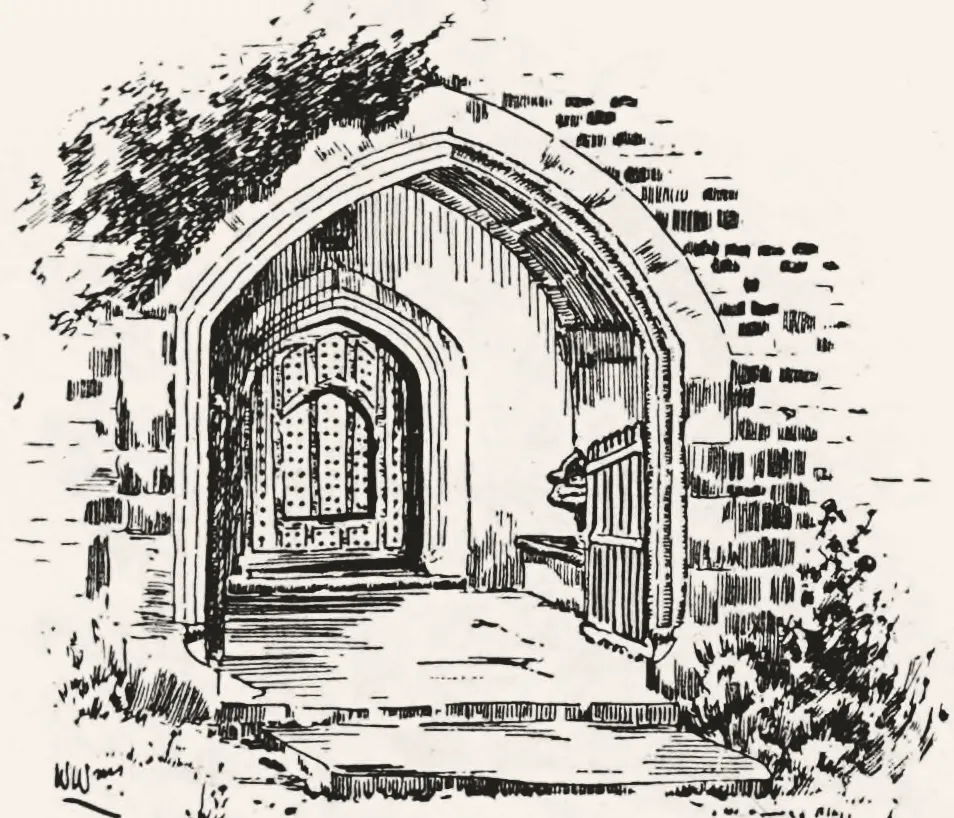
The time-stained oak door in the porch. Warren Williams, 1899The priest's door in the chancel wall. Warren Williams, 1899
Repairs, not rebuilding
The church was repaired in the 1660s, after the Civil War: the font and a roof timber in the south aisle are both dated 1661. In 1896 E. G. Davies renewed the roofs of the nave and chancel.
In 1909–10 the London architect William Weir restored the church with advice from the Society for the Protection of Ancient Buildings. The Society's rule was to repair old work gently rather than replace it. That is why St Bridget's escaped the heavy rebuilding many Victorian churches suffered, and why Cadw lists it Grade I as “an important medieval church” with “an exceptionally good interior”.
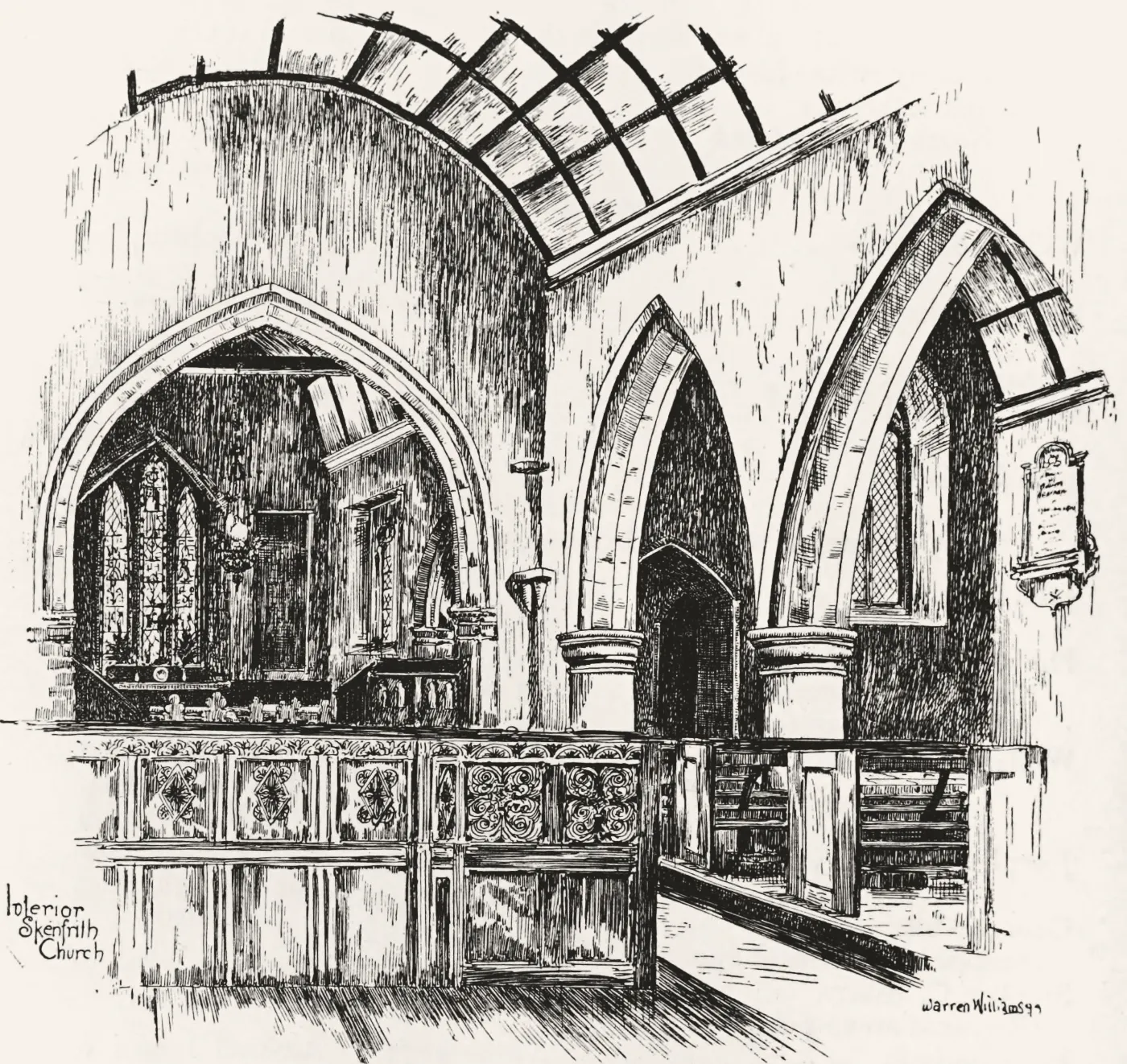
Warren Williams drew the interior in 1899, before this restoration, and his drawing shows the old seating.
The interior before the restoration of 1910. Warren Williams, 1899
Treasures
Trysorau
The Skenfrith Cope
A cope is a long ceremonial cloak worn by a priest. The Skenfrith Cope was made in England in the late 1400s or around 1500. Its embroidery was worked in coloured silks and silver-gilt thread on canvas, then stitched onto red velvet.
In the centre, the Virgin Mary is carried up to heaven by three angels, with seraphs around her. The rest is scattered with fleurs-de-lis, pomegranates and double-headed eagles. The hood shows the Virgin holding the infant Christ. Along the front border, saints stand under canopies. One of them is St Andrew; the others are too worn to name.
Nobody knows how it survived the Reformation, when most church vestments in England and Wales were destroyed or sold. By the 1840s it was serving as a cover on the communion table. A Catholic priest, Father Abbott, remembered in 1897 how he had found it “rotting in the damp on the Communion Table” about fifty years before. He offered the churchwardens a new cloth in exchange, but they had to ask the Dean. Soon afterwards, at an archaeological meeting at Grosmont, the Dean of Hereford, John Merewether, sent for the Cope, recognised it for what it was, and ordered that it be properly cared for.
The vicar of the day had little time for Catholic things. According to Father Abbott, he told the village it was “a Coat of King John’s”, and local people added that King John had worn it to sign Magna Carta.
A glass case was made for it in the 1910 restoration. In the early 1980s the textile historian Kirstie Buckland repaired it, and in 1983 she published the specialist study, The Skenfrith Cope and its Companions. By 2011 it was suffering from damp, dirt and mould, and it spent a year at Janie Lightfoot’s conservation studio in London, paid for largely by the Friends of St Bridget’s. It came home on St Bridget’s Day, 1 February 2013, when the Abbot of Belmont and some of his monks joined the service of thanksgiving.
It hangs in its case in the north aisle. The curtains keep the light off it: please draw them back to look, and close them again afterwards.
The tomb of John and Anne Morgan
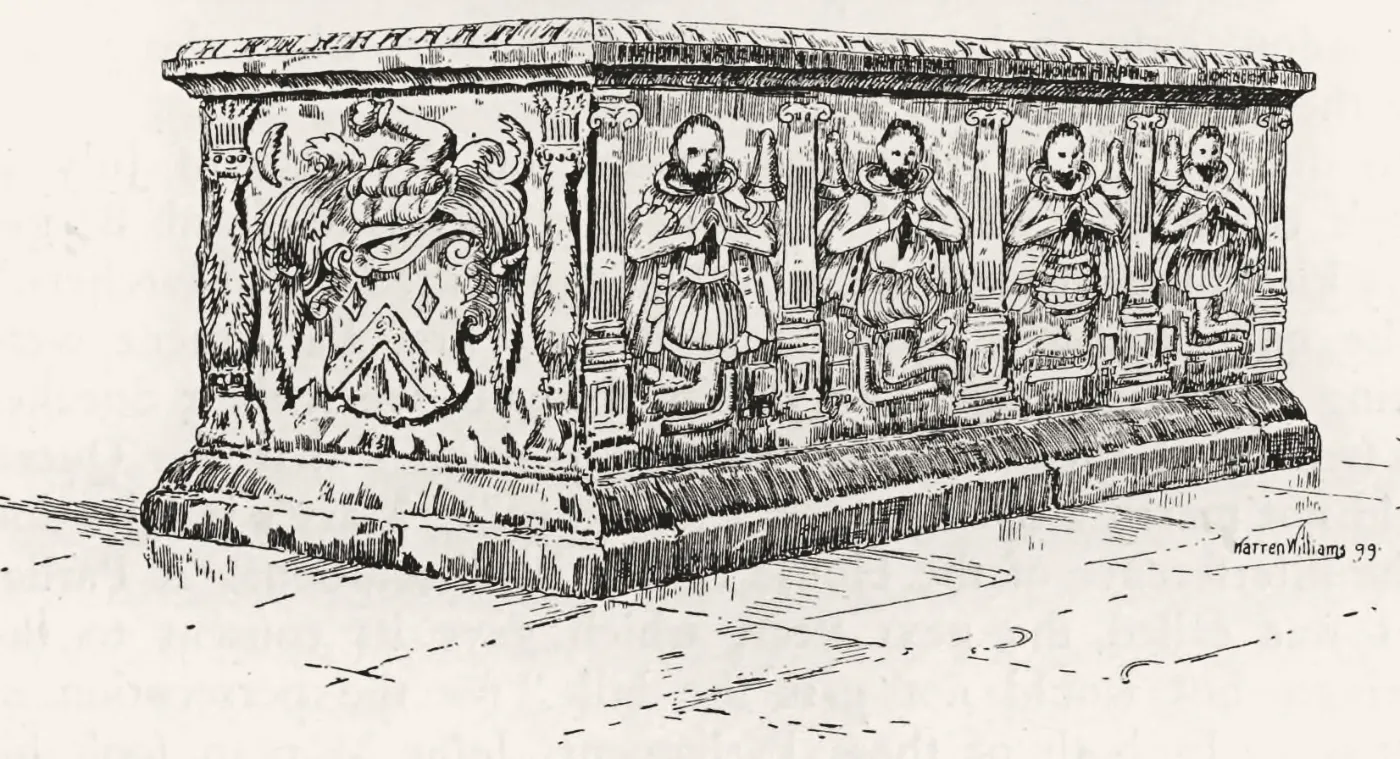
At the east end of the north aisle stands the chest tomb of John Morgan, who died in 1557. He was steward of the Duchy of Lancaster, the last governor of the Three Castles, and MP for the Monmouth boroughs in 1553 and 1554.
John and his wife Anne are engraved on the lid, framed by an inscription in Latin. Anne, who died in 1564, came from the Cecil family, and the Cecil arms are carved on one end of the tomb. Along the sides kneel the mourners: four men, probably their sons, on the south side and four women on the north. A later inscription, “IM obit 75 1587”, seems to record another of the family.
According to the 1926 account of the church, John Morgan’s brother was Sir Richard Morgan of Blackbrook, the judge who tried Lady Jane Grey, and he left 6s 8d in his will of 1546 towards repairs to this church. The same account notes that the tomb had at some time been damaged.
The tomb of John Morgan. Warren Williams, 1899
The Morgan pew and the minstrels' pew
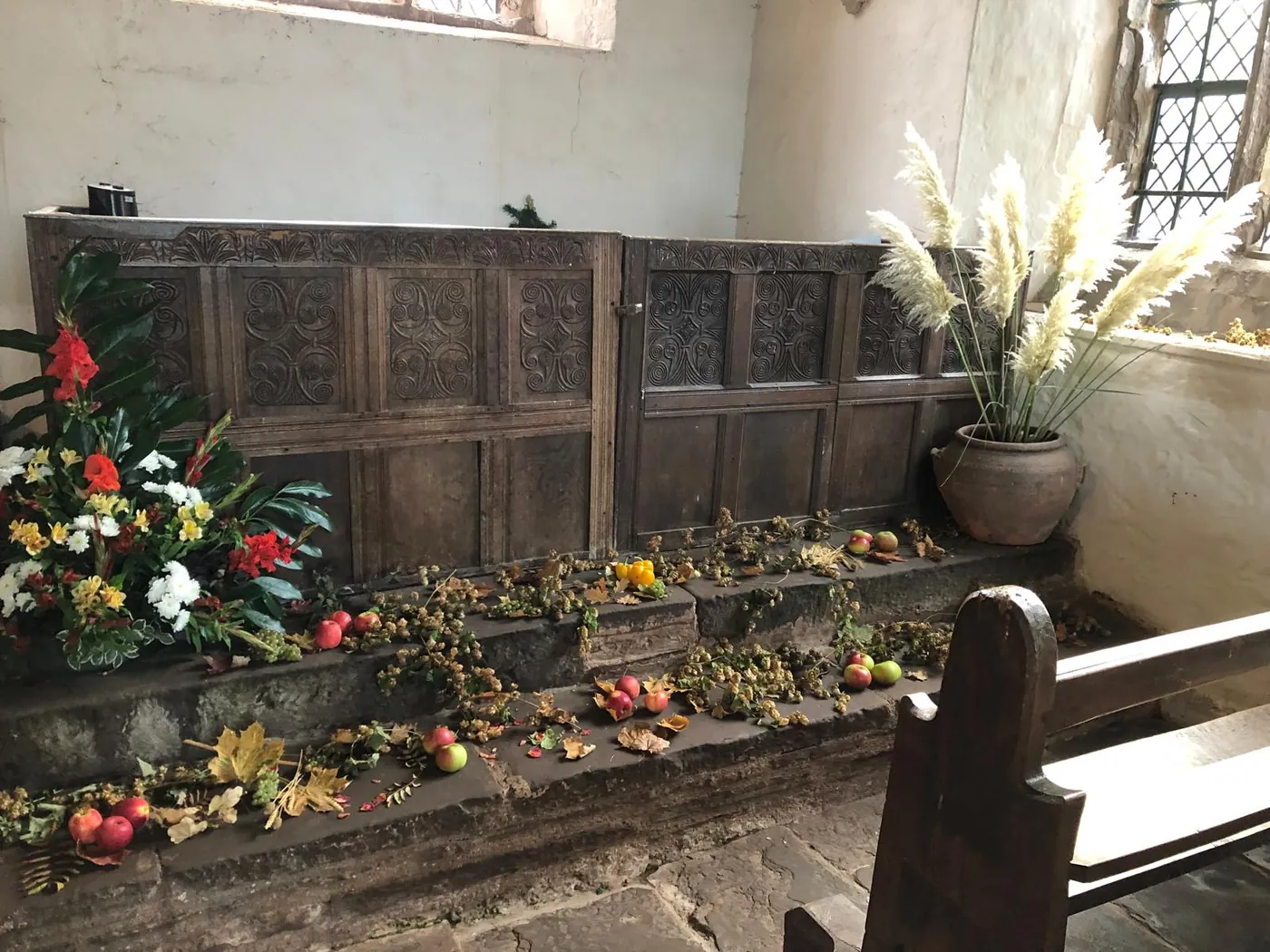
At the west end of the north aisle is the Morgan family pew, from the early 1600s, with two tiers of carved panels and a gadrooned top rail. At the east end of the south aisle is the so-called minstrels' pew, from the 1500s or 1600s, with two tiers of eight panels carved with scrollwork. It has been moved from its original place. Beside it is a block of three old oak benches. In 1855 the vicar, William Speke, took out the old box pews and moved the minstrels’ pew; it was restored in 1910. The rest of the pews and the choir stalls date from that restoration.
The carved panels of an old pew, dressed for harvest. J. Foster
Furnishings and wall paintings
The reading desk in the chancel is made from pieces of the medieval rood screen, with simple pierced tracery. The communion rail is from the 1600s, and the octagonal font is dated 1661. The lectern shows St Bridget with her emblems: an acorn, a lamp, and the floating sod of turf from her legend. It was given in 1910 in memory of Leyton Pershouse Thomas, a grandson of the patron, who died in 1906 aged 16. It is usually credited to the Arts and Crafts carver George Jack, though the 1926 account of the church names Richard Jack RA.
Look up in the sanctuary for carved bosses: St Bridget’s acorns, a fleur-de-lis, the red rose of Lancaster, the Tudor rose and a pomegranate. The church plate includes a communion cup and paten of 1693, and the old parish chest of about 1600 has three locks.
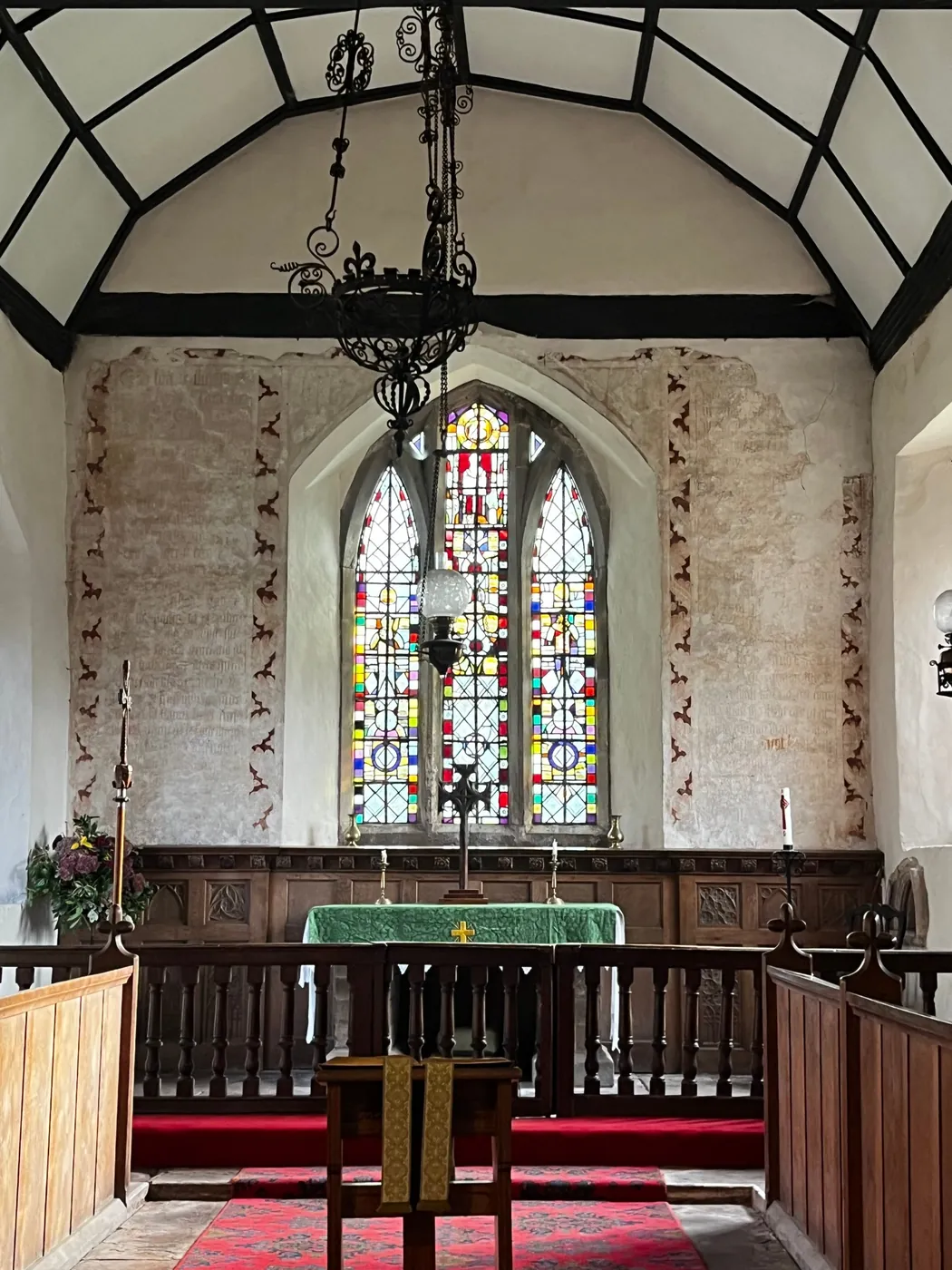
Faint wall paintings survive on the east walls. On the south aisle are traces of a 15th-century “Sunday Christ”, a medieval warning against working on the Sabbath, which showed Christ surrounded by tools. The Ten Commandments, painted in black letter in the late 1500s, were copied and renewed in 1910, and a text from Ecclesiastes dates from the 1660s. Small pieces of medieval glass survive in the east window.
The chancel, east window and painted texts. J. Buchanan
The bells
Y clychau
The dovecote belfry holds a ring of six bells, all cast in 1764 by Thomas Rudhall of the famous Gloucester bell foundry. The parish register records that “Sconfreth the newe six belles first began to ring 15th of January 1765”. The heaviest, the tenor, weighs about 395 kilograms (7¾ hundredweight).
Each bell carries an inscription:
Treble: “When you us ring, We’ll sweetly sing.”
Second: “The living to the Church I call, And to the grave will summon all.”
Third: “The Reverend Mr Davies and Joseph Hosten, Churchwardens, 1764.”
Fourth: “Thomas Rudhall cast us all in 1764.”
Fifth and tenor: “T. R. 1764.”
The bells were rehung in the 1910 restoration, and again in 2006, when they were overhauled and given a new cast-iron frame. They are still rung today.
Vicars and patrons
Ficeriaid a noddwyr
The list of vicars goes back more than 800 years. Here are some of them.
1207
Matthew de Hereford, the first priest known by name.
1267
Henry de Vien, who witnessed a grant by the Abbot of Dore.
1535
Sir Thomas ap Jevon, named in Henry VIII’s great survey of church wealth. (“Sir” was then a courtesy title for priests.)
1591
Roger ap Rosser, in whose time the Ten Commandments were probably painted on the walls.
1613–1642
David Lewis, turned out after 29 years for his loyalty to Charles I, “plundered and undone, and his family reduced to much misery”.
1654
Lewis Parry, appointed by Cromwell’s commissioners.
1679–1725
James Phillippes, vicar for 46 years, buried in the sanctuary with his wife and two daughters.
1841
George Miller, who stopped the wake and the churchyard sports.
1850
Stephen Cattley Baker, who repaired the stone pulpit.
1855
William Speke, who took out the old box pews.
1889–1923
Christopher Leonard Garde, vicar through the 1910 restoration and the First World War.
The right to choose the vicar, called the advowson, changed hands many times. In the 1200s it belonged to the Crown and the lords of the castle. From 1291 it belonged to Grace Dieu Abbey, until Henry VIII closed the abbey. Later it passed to the Morgans and then the Cecil family. The Cecils sold it in 1790 for £656. Sarah Pugh bought it in 1830, the Speke family bought it in 1854 for £700, and by 1901 it belonged to Robert Newton Jackson of Blackbrook. After the Church in Wales was disestablished in 1920, the Bishop of Monmouth took over the choice.
Parish life
Bywyd y plwyf
The wake
The great day of the year was the wake, held in the churchyard on the Sunday after St Bridget’s Day. Skenfrith was “gay with booths and coloured streamers”, and the farmers settled the past year’s quarrels by wrestling in the churchyard. The custom was to put a big bun on a stake. The scramble for a bite usually started a fight, in which many were “knocked about above a bit”, as one villager remembered in 1899. The village then had five public houses. Parson Miller put an end to the wake in 1841.
The churchyard
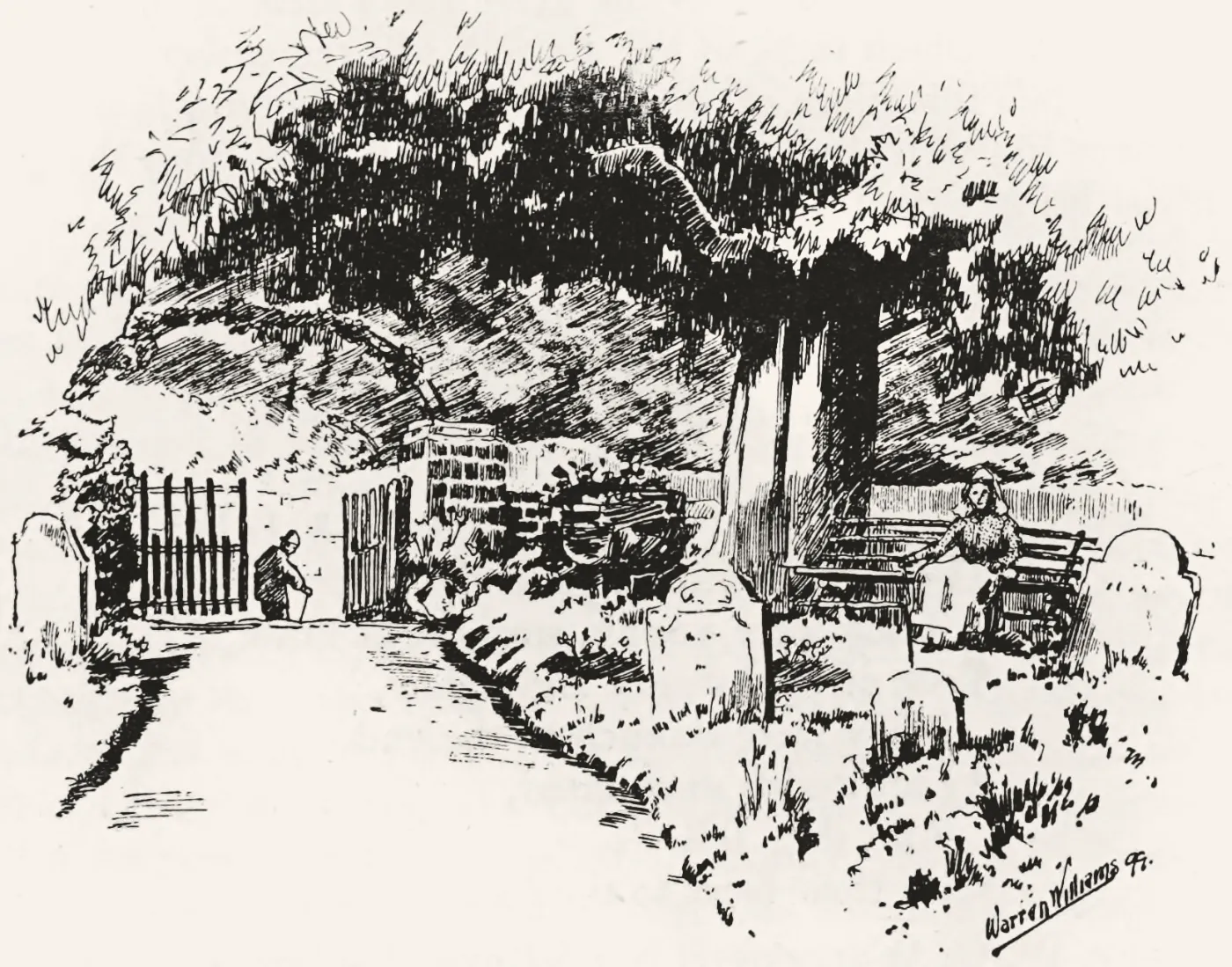
Villagers once played ball against the north wall of the church and sat drinking cider on the tombstones. The village stocks stood by the gate under the great yew. By 1899 a rustic seat had taken their place, the one Warren Williams drew. The yew is still there, recorded as an ancient tree more than four and a half metres round.
The rustic seat by the churchyard gate, where the stocks once stood. Warren Williams, 1899
The registers
Skenfrith’s parish registers survive from 1639, with gaps, and are kept at the National Library of Wales. Among the burials are “Old Hugh y loder to y Mill” in 1728 and “Judeith y Ginger bred maker” in 1763. In 1825 John Probyn was buried, “upwards of sixty years Clerk of this Parish, aged 85”.
Catholic Skenfrith
After the Reformation, many families around Skenfrith quietly kept the old faith. In Elizabeth I’s reign the Catholic writer Robert Gwyn spent much of his last years in the border parishes of Skenfrith and Grosmont. The poet Gwilym Pue found refuge at Blackbrook. In 1847 a Catholic chapel, dedicated to the Immaculate Conception, was built at Coedangred, with its own burial ground.
Memorials in the church
Besides the Morgan tomb there are tablets to John Gwilliam (died 1793) and to Mary Carter of the Brook House (died 1801), a wooden memorial to William and Rebecca Bovan (died 1760 and 1762), and a notice of Elizabeth Davis, who died in 1878 aged 96. She left £100 to keep the family tomb in repair and to buy blankets for the poor. A plaque also remembers the conductor Vernon “Tod” Handley and his support of British composers.
Remembrance
Er cof
The village war memorial is the tall wheel cross beside the road between the village and the bridge. The parishioners put it up “to the glorious memory of the men of this parish who made the supreme sacrifice in the Great War”. Unusually, it names not only the nine men who died but also the 42 who served and came home. Three names were added after the Second World War. It is Grade II listed, and it is where the Remembrance Sunday service is held.
Inside the church, a plaque given by their grandparents, “R and M N J” of Blackbrook, remembers four Thomas brothers:
Leyton Pershouse Thomas, who died at Blackbrook in 1906, aged 16. The lectern is his memorial.
Lieutenant Trevor Thomas, Royal Welch Fusiliers, killed at Neuve Chapelle on 10 January 1916, aged 18.
Captain Robert Newton (Robin) Thomas, Royal Welch Fusiliers and Royal Flying Corps, holder of the Croix de Guerre, killed at Gaza on 23 July 1917, aged 26.
Captain Owen Vincent Thomas, Royal Air Force, who died after a night-flying accident on 29 July 1918, aged 24.
Their grandmother at Blackbrook wrote Bygone Days in the March Wall of Wales (1926), “compiled before the War for my dear Grandsons who have made the Supreme Sacrifice”. Its roll of honour for Skenfrith names Capt. W. G. Walford, Capt. Robin Thomas, Capt. Vincent Thomas, Lieut. Trevor Thomas, Lieut. Arthur Mardon, Sergt. A. Jones, Corpl. H. Lawrence and Corpl. H. Vaughan. The cross itself records nine. A second tablet to Owen Vincent Thomas was put up by a comrade from the Somme.
Floods and recent years
Llifogydd
The Monnow has always shaped Skenfrith. In October 2019 flood water stood 1.2 metres deep against the church wall. In February 2020 Storm Dennis flooded 22 homes and businesses in the village. Storm Bert flooded the village again in November 2024.
In November 2025 Storm Claudia overwhelmed the flood barriers. More than 40 centimetres of water came into the church, leaving silt across the floor, but the Cope was unharmed. Volunteers cleaned the church afterwards.
Happier moments too. On 24 and 25 February 2010 the BBC filmed Doctor Who around the church lane and churchyard wall, with Skenfrith playing the sleepy village of “Upper Leadworth” in Amy's Choice, broadcast that May. The National Churches Trust gave a repair grant in 2007, and the Friends of St Bridget’s, set up in 2010, raised much of the money for the Cope’s conservation.
Fact or tradition?
Ffaith neu draddodiad?
Old churches gather stories. Here is what the records say about some you may hear.
“Consecrated in 1207”
Tradition
Often repeated, but no record of a consecration has been found. What 1207 does give us is the payment by Matthew de Hereford, which shows the church already existed.
“Older than the Normans”
Possible, unproven
The Welsh dedication and place name hint at early roots, but nothing in the building is older than about 1200.
“The tower was a refuge from raiders”
Plausible
Its thick walls and tiny openings fit the idea, and this was a troubled border. No record says it was used that way.
“John Morgan hid the Cope”
Unproven
A Catholic governor saving a vestment is an appealing story, and it is told in the church. How the Cope survived is genuinely unknown.
“The head over the porch is St Bridget”
Tradition
The worn carved head above the porch door is locally said to be the saint. There is no inscription to confirm it.
“The Cope was King John’s coat”
Myth
A Victorian vicar’s explanation, and the village added that John signed Magna Carta in it. The Cope was made nearly three centuries after John died.
“The north door was opened for the Devil”
Folklore
An old belief, recorded in 1926, was that at a baptism the north door was opened so the Devil could “flee to his own place”.
“The altar stone was buried at the Reformation”
Tradition
The parish guide tells of the old stone altar being thrown down, buried and later put back. It is a good story; we have not found an independent record.
Sources and further reading
Ffynonellau
This page was put together in November 2026 from the sources below, checked against each other. Where they disagree, we say so. If you know more, or spot a mistake, please get in touch.
Books: Kirstie Buckland, “The Skenfrith Cope and its Companions”, Textile History 14 (1983); Sir Joseph Bradney, A History of Monmouthshire, vol. 1 (1907); John Newman, The Buildings of Wales: Gwent/Monmouthshire (2000); Richard Suggett, Painted Temples (2021); Revd A. W. McAdam, St Bridget's Church, Skenfrith (parish guide); Warren Williams, Bygone Days in the March Wall of Wales (drawings).
❧This history is dedicated to the memory of John and Avril Chapman, who loved St Bridget's.